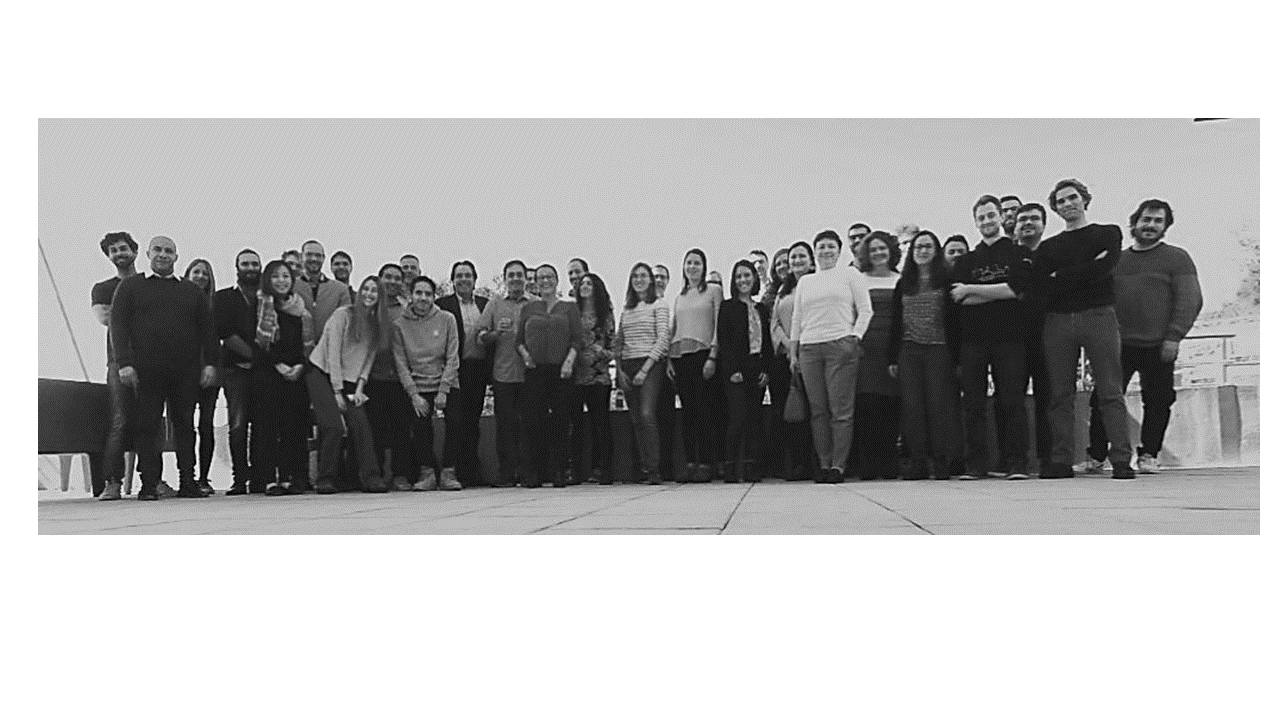
From 23 to 25 March, SimCardioTest organised its first General Assembly. Time was dedicated to share updates on each workpackage and use case advances. Intensive hands-on sessions were also organised to define the different potential applications and questions of interest for each use case, a key aspect in the Verification & Validation process.
The first Advisory Board meeting was also successfully organised with Nicolas Duchateau (Univ. Lyon), Ken Wang (Roche), Nathalie Virag (Medtronics), Richard Gray (FDA), Flora Musuamba Tshinanu (EMA).
In total, fifty six scientists met for three days at Inria, Sophia Antipolis.Agenda-GeneralAssembly23-25March FINAL.
To summarise the work done in one year:
Hermenegild Arevalo, Simula, leader of the working group (WG) on standardization of
the process for each product development/each use case, presented the workflow,
software used (commercial or open source) and their integration into the in-silico trials (IST) platform.
Yves Coudière, University of Bordeaux, leader of the WG on pacemaker, has presented the computer simulation for catheters & pacing leads, with a focus on computational models to understand navigation of the leads, the electrophysiology of the leads and long-term mechanical effort of the leads. Two sets of computational pipelines are designed:
- Electrophysiology (compute lapicque curve, use open source software
CEPS), model of simple model of impedance, (evaluation of the distribution of energy that is really delivered in the tissue). - Mechanics: evaluate navigation (compute forces) and fatigue (number of cycles until it breaks). Issue: difficult to have an interactive navigation with the model.
Ongoing: Design a beating heart phantom to get experimental data on mechanical process. Need to use clinical data. And ongoing risk analysis for V&V.
Oscar Camara, Universitat Pompeu Fabra, leader of the WG on LAAO, has presented the devices for LAA as an alternative of anti-coagulant. The context is that it exists different devices for which types and size can vary. We need better tools to minimize risks of adverse event of implantation. We need good data on morphology and on hemodynamics. In-silico simulation can be used to predict the device settings, but published literature is diverse and lack of UQV&V.
Ongoing work: Design V&V plan on fluid simulation, sensitivity analysis, identification of specific boundary conditions, validation by in-vitro experiments and data from CHU to generate the largest database on LA-based simulation. Develop methodology to accelerate fluid simulation by deep learning and integration into the in-silico platform.
Benchmark study between commercial and open source software ongoing. Build In-vitro phantom in collaboration with MIT to impose realistic movement of the LAA wall, studies between different vendors of devices, and geometric deep learning.
On the IST platform, it exists a large virtual population of simulation precomputed where the user will upload its data and the platform will find the closest match to visualize all simulations related to the example. Or the user will upload a new device, that will be implanted, and tested on 100 cases, or sub-set, run the simulation and see the report on the device.
Beatriz Trenor, Universitat Politecnica de Valencia, leader of the WG on drugs efficacy and safet reminded the main objective of this use case: to set up cases to be implemented in the IST platform to test drugs (efficacy or safety), design of pharmacokinetics (PK) models of drugs to introduce the outcomes (plasma concentration, etc.) into electrophysiological (EP) and electromechanical (EM) models of the cell or organ in healthy or pathological situations to assess the effect of drugs.
So far, many PK models of some drugs have been built, for which the CiPA list of drugs has been established, to evaluate the safety of the drugs to be tested. For efficacy, some drugs have also been identified and the modelisation of those drugs are ongoing. Ongoing test on EP & EM models at the cellular level (comparing healthy/AF, ischemia or Heart failure population, male/female population).
Next step: Measure of the effect of these drugs in 3D models (ventricles or atria). Models can include ischemia or AF conditions. Building credibility of these models
Valerie Centis, Microport, leader of the WG on V&V, uncertainty quantification presented the objectives of this WP: verify, validate quantify uncertainty, assess the relevance of EMA/FDA documents and initiate discussions towards a novel evaluation model.
Liesbet Geris, VPHi, leader of the WG on Dissemination and stakeholder’s awareness building presented the strategy to reach different groups: medical community, including the clinical community, patients organisations, Regulatory community, Citizens
SimCardioTest scientists on 24th March 2022, at Inria, Sophia Antipolis.